
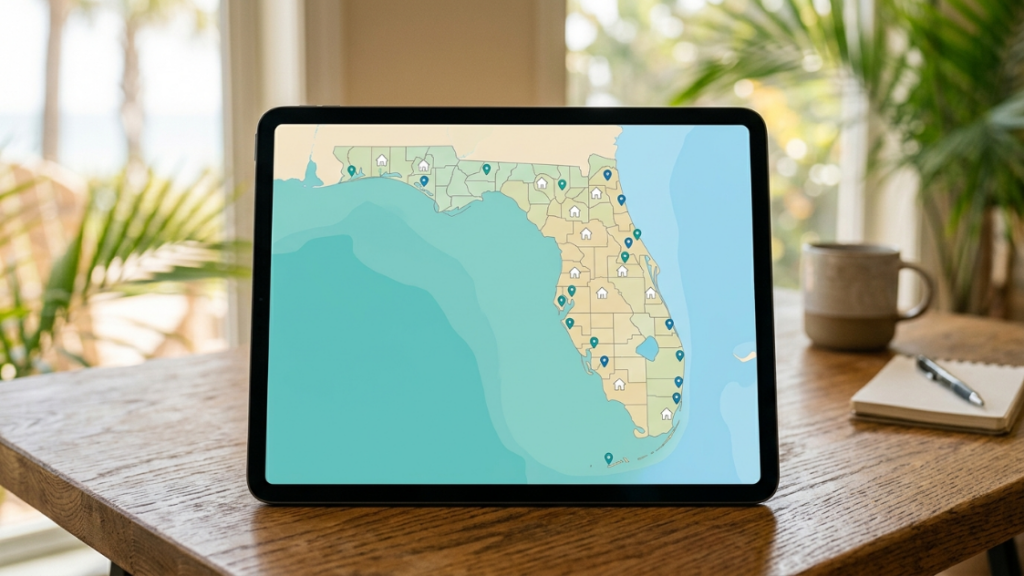
Florida home insurance rates can vary dramatically from one county to another. A homeowner in an inland North Florida county may pay much less than a homeowner in the Florida Keys, South Florida, or a coastal Gulf county. Even within the same county, two homes can receive very different quotes based on roof age, construction type, wind mitigation features, replacement cost, claims history, flood exposure, and the insurance company’s appetite for that area.
That is why county-level averages are helpful, but they are only a starting point. They can show general patterns across the state, but they cannot predict the exact premium for one specific home.
According to the Florida Office of Insurance Regulation’s January 2025 Property Insurance Stability Report, OIR calculated county-level average premiums by dividing total premium by policies in force with wind coverage by county. OIR also cautions that actual charged premiums vary based on company, insured value, deductibles, and policy terms. The report’s county data represents information reported as of September 30, 2024.
For Florida homeowners, the main takeaway is simple: where your home is located matters, but it is not the only thing that matters.
Why Florida Home Insurance Rates Vary by County
Florida is one of the most complex homeowners insurance markets in the country. The state has hurricane exposure, coastal development, high rebuilding costs, litigation history, reinsurance costs, older housing stock, flood exposure, and severe weather risk. Those factors are not evenly distributed across the state.
A home in Monroe County may face very different wind, storm surge, and rebuilding challenges than a home in Sumter County. A home in Miami-Dade, Broward, or Palm Beach may face different market conditions than a home in Alachua, Marion, or Leon County. A beachfront property in Sarasota County may price differently than an inland property in the same county.
Insurance companies evaluate county-level risk, but they also look at the individual home. That means your premium may be higher or lower than your county’s average.
Florida County Home Insurance Rate Examples
The Florida Office of Insurance Regulation’s January 2025 report provides average premiums charged for homeowners and condominium unit owners in all 67 Florida counties. The report shows a wide range of average homeowners premiums.
For example, Monroe County had one of the highest average homeowners premiums in the report at $9,058, while Sumter County was much lower at $2,064. Other high-cost counties included Palm Beach at $6,614, Broward at $6,290, Miami-Dade at $6,045, Desoto at $6,168, Collier at $5,604, Gadsden at $5,464, and Walton at $5,376.
Some lower or moderate county averages in the same report included Martin at $2,213, Baker at $2,313, Highlands at $2,330, Wakulla at $2,360, Citrus at $2,441, Alachua at $2,451, Clay at $2,492, Lee at $2,519, and Pasco at $2,691.
These numbers are not quotes. They are averages based on policies in force with wind coverage. Your actual premium may be very different.
County-Level Rate Snapshot
Here is a sample snapshot from OIR’s county average premium data:
| County | Average Homeowners Premium |
|---|---|
| Monroe | $9,058 |
| Palm Beach | $6,614 |
| Broward | $6,290 |
| Desoto | $6,168 |
| Miami-Dade | $6,045 |
| Collier | $5,604 |
| Walton | $5,376 |
| Pinellas | $3,882 |
| Sarasota | $3,590 |
| Orange | $3,427 |
| Hillsborough | $2,653 |
| Lee | $2,519 |
| Alachua | $2,451 |
| Highlands | $2,330 |
| Martin | $2,213 |
| Sumter | $2,064 |
This table is useful for understanding broad county differences, but it should not replace a personalized quote. GreatFlorida Insurance homeowners insurance guide also reports that Florida is one of the most expensive states for homeowners insurance, with statewide averages varying significantly depending on coverage assumptions, including hurricane deductible selections.
Coastal Counties Often Have Higher Premiums
Many of Florida’s highest-cost counties are coastal or storm-exposed. Monroe County, Miami-Dade, Broward, Palm Beach, Collier, Pinellas, Sarasota, Walton, Bay, and other coastal areas can face elevated wind, hurricane, storm surge, and rebuilding risks.
Coastal exposure can influence rates because insurers must consider the chance of severe wind damage, roof damage, water intrusion, and total-loss scenarios. Homes near the coast may also be more expensive to rebuild because of labor costs, construction codes, access challenges, and demand after a major storm.
However, “coastal” does not automatically mean every home in the county has the same premium. A newer inland concrete-block home with a recent roof and strong wind mitigation features may cost less to insure than an older home closer to the water with an aging roof.
Inland Counties Can Still Have High Rates
It is easy to assume only coastal counties have expensive home insurance, but that is not always true. The OIR report shows some inland or less obviously coastal counties with relatively high averages, including Gadsden, Desoto, Jackson, Hamilton, Leon, and Okeechobee.
There are several reasons this can happen. A county average may be affected by the mix of homes insured, carrier participation, claims history, roof age, insured values, reinsurance costs, and the number of policies in force. In smaller counties, fewer policies can sometimes make averages more sensitive to the types of homes included in the data.
That is why homeowners should avoid relying only on coastal-versus-inland assumptions. Your home’s characteristics matter.
What Drives Your Florida Home Insurance Rate?
County is only one part of the rating process. Your individual premium may depend on many factors.
Replacement Cost
Homeowners insurance is generally based on the cost to rebuild your home, not necessarily the market value or purchase price. A home with higher replacement cost usually needs more dwelling coverage, which can increase the premium.
Roof Age and Roof Type
Roof age is one of the biggest pricing and eligibility factors in Florida. A newer roof may help you qualify for more options, while an older roof may limit carrier choices or increase premium. Roof shape and material also matter. Hip roofs, metal roofs, tile roofs, and shingle roofs may be rated differently.
Wind Mitigation Features
Florida homes with wind-resistant features may qualify for credits. These may include roof-to-wall connections, opening protection, secondary water resistance, roof deck attachment, and other wind mitigation characteristics.
Construction Type
Concrete block, frame, masonry, and other construction types can affect premium. Insurers consider how the home may perform during wind, water, and fire events.
Deductibles
Florida homeowners policies may include a standard deductible and a separate hurricane or windstorm deductible. Higher deductibles may lower the premium but increase what you pay after a claim.
Claims History
Prior claims can affect pricing and eligibility. Insurers may review claims associated with the property and with the policyholder.
Coverage Choices
Optional coverages, higher personal property limits, water backup, ordinance or law coverage, screened enclosure coverage, pool cage coverage, and other endorsements can affect the final premium.
Why Hurricane Deductibles Matter
Florida homeowners should pay close attention to hurricane deductibles. A policy may show a lower annual premium but include a higher hurricane deductible. That can make a big difference after a storm.
A hurricane deductible is often expressed as a percentage of the dwelling coverage limit. For example, if your home is insured for $400,000 and your hurricane deductible is 2%, you may be responsible for $8,000 before insurance begins paying for covered hurricane damage.
When comparing home insurance rates by county, make sure you are comparing similar deductible structures. A quote with a 5% hurricane deductible is not the same as a quote with a 2% deductible.
How much could you save on Florida Homeowners Insurance? It takes two minutes to find out.
Get a Free QuoteFlood Insurance Is Separate
Homeowners insurance and flood insurance are not the same. Standard homeowners insurance usually does not cover flood damage caused by rising water, storm surge, overflowing bodies of water, or heavy rain that enters from the ground up.
This is especially important in Florida, where flood risk exists both on the coast and inland. A county with high homeowners insurance rates may also have significant flood exposure, but the homeowners premium may not include flood insurance.
The Insurance Information Institute explains that standard homeowners insurance covers many common losses, but homeowners should understand what is and is not included in the policy. Flood coverage is typically purchased separately.
How to Compare Home Insurance Rates by County
Florida homeowners can use county-level averages to understand the market, but quotes should be compared home-by-home. The Florida Office of Insurance Regulation offers the CHOICES homeowners rate comparison tool, which provides sample average rates for companies writing insurance in each county.
When comparing quotes, look beyond the premium. Compare:
- Dwelling coverage
- Other structures coverage
- Personal property coverage
- Loss of use coverage
- Liability limits
- Hurricane deductible
- All other peril deductible
- Wind or hail exclusions
- Water damage limits
- Roof settlement terms
- Ordinance or law coverage
- Screened enclosure coverage
- Carrier financial strength
- Claims reputation
The cheapest policy may not be the best option if it leaves major gaps.
Florida Counties With Higher Rate Pressure
Based on the OIR county averages, homeowners in Monroe, Palm Beach, Broward, Desoto, Miami-Dade, Collier, Gadsden, Walton, Jackson, Hamilton, Pinellas, Okaloosa, Leon, and Okeechobee may see higher average premiums than many other counties.
Some of these counties are coastal. Others may reflect different market, claims, housing stock, or data factors. The point is not that every home in those counties will be expensive. The point is that county averages can signal where homeowners should pay extra attention to coverage, deductibles, and mitigation options.
Florida Counties With Lower Average Premiums
The OIR data also shows several counties with comparatively lower average homeowners premiums, including Sumter, Martin, Baker, Highlands, Wakulla, Citrus, Alachua, Clay, Lee, Franklin, Putnam, Hillsborough, Union, Gilchrist, Pasco, Polk, Lafayette, Escambia, Hardee, Taylor, Liberty, Osceola, Jefferson, Manatee, Volusia, and Suwannee.
Again, these are averages. A waterfront home, older roof, prior claim history, high replacement cost, or limited carrier eligibility can still lead to a higher premium in a lower-average county.
How Homeowners May Lower Insurance Costs
There are several ways Florida homeowners may be able to improve pricing or eligibility.
Start with a wind mitigation inspection. If your home has qualifying wind-resistant features, the inspection may help you receive credits. If your home does not have those features, the inspection may show which improvements could matter most.
Consider roof updates when appropriate. A newer roof can sometimes expand carrier options and improve pricing. Also review opening protection, roof-to-wall attachments, and secondary water resistance.
Ask about deductible options, but be careful. Raising deductibles can reduce premium, but it can also create a large out-of-pocket cost after a claim.
Bundle policies where it makes sense, but do not assume bundling is always cheapest. Compare multiple carriers.
Review your dwelling limit annually. Underinsuring the home to save money can create a serious problem after a loss.
Final Thoughts
Florida home insurance rates vary widely by county, but county is only one piece of the puzzle. Monroe, Palm Beach, Broward, Miami-Dade, Collier, Walton, and other higher-cost areas may show elevated averages, while counties such as Sumter, Martin, Highlands, Alachua, Lee, and Hillsborough may appear lower in statewide comparisons. Still, every home is rated individually.
The most useful approach is to combine county-level awareness with a detailed review of your specific home. Roof age, replacement cost, wind mitigation, construction type, deductibles, coverage choices, and carrier appetite may all affect your final premium.
A GreatFlorida insurance agent can help you compare quotes, understand county-specific rating pressures, evaluate coverage options, and identify ways to improve protection without sacrificing important coverage.
Frequently Asked Questions About Florida Home Insurance Rates by County
1. Which Florida county has the highest home insurance rates?
Based on the Florida Office of Insurance Regulation’s January 2025 Property Insurance Stability Report, Monroe County had the highest average homeowners premium among the counties listed, at $9,058.
2. Which Florida county has the lowest home insurance rates?
Based on the same OIR report, Sumter County had one of the lowest average homeowners premiums listed, at $2,064.
3. Why do Florida home insurance rates vary by county?
Rates vary by county because of hurricane risk, coastal exposure, claims history, construction costs, carrier availability, roof age, insured values, and local property characteristics.
4. Are coastal counties always more expensive?
Coastal counties are often more expensive, but not every coastal home has the same rate. Roof age, construction type, wind mitigation, deductibles, and exact location can change the premium.
5. Can inland Florida counties still have high home insurance rates?
Yes. Some inland counties may have higher averages because of claims history, housing stock, replacement costs, carrier appetite, or the mix of policies in force.
6. Does county average premium predict my exact quote?
No. County averages are only a guide. Your actual premium depends on your home, coverage, deductibles, insurer, roof, claims history, and other rating factors.
7. Does homeowners insurance include flood insurance?
Usually not. Flood insurance is typically separate from a standard homeowners policy.
8. How can I compare rates in my county?
You can compare quotes through a local insurance agent and review the Florida Office of Insurance Regulation’s CHOICES rate comparison tool for sample rates by county.
9. Can wind mitigation lower Florida home insurance costs?
Yes, qualifying wind mitigation features may help reduce premiums by providing credits, depending on the home and insurer.
10. What should I compare besides price?
Compare coverage limits, hurricane deductibles, water damage limits, roof settlement terms, exclusions, endorsements, carrier strength, and claims service.
Ready to save on Florida Homeowners Insurance?
GreatFlorida Insurance Agents compare rates from Florida's best carriers for you.
Get a Free QuoteOr call 888.478.7801