


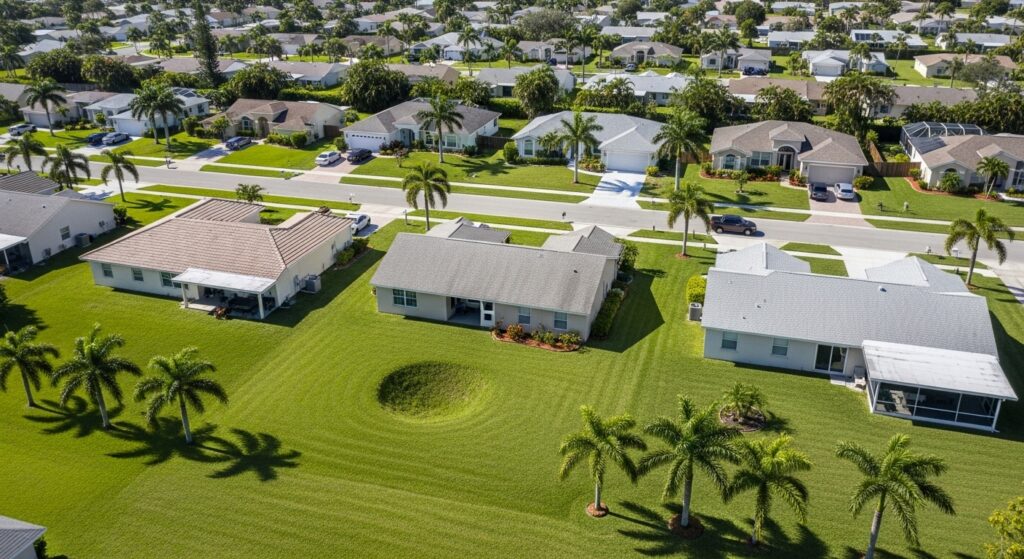
Florida sits on limestone, and limestone dissolves. That is why the state records more sinkhole activity than anywhere else in the country, and why a handful of counties absorb most of the claims filed each year.
Key Takeaways
- Pasco, Hernando, and Hillsborough counties report the most confirmed sinkholes in Florida.
- Sinkhole loss coverage is optional and typically carries a 10% deductible but is worth considering in high-risk counties.
- Standard homeowners policies include only catastrophic ground cover collapse coverage, not routine sinkhole damage.
Key takeaways
- Three counties, Pasco, Hernando and Hillsborough, form Florida’s “sinkhole alley” and account for the majority of reported activity.
- Standard Florida homeowners policies must include catastrophic ground cover collapse, but full sinkhole coverage is a separate optional endorsement.
- Sinkhole testing and repair claims run into six figures, which is why carriers price the endorsement at roughly 10% to 45% of base premium.
- Florida law gives you two years from discovery to file a sinkhole claim.
Top 10 sinkhole-prone counties in Florida (2026)
The ranking below reflects reported subsidence activity and insurer claim concentration as of 2026. The top three have been stable for more than a decade, while the lower half shifts year to year with rainfall and groundwater pumping.
- Pasco County, the highest reported activity in the state, centered on Land O’ Lakes, Hudson and the southern edge of Spring Hill.
- Hernando County, Brooksville and Spring Hill, with dense residential development over shallow limestone.
- Hillsborough County, northern and eastern Tampa, plus the Plant City agricultural pumping zones.
- Marion County, Ocala and the surrounding horse country.
- Citrus County, Inverness and Crystal River.
- Pinellas County, concentrated inland rather than on the coastal barrier islands.
- Polk County, Lakeland, Winter Haven and the phosphate mining corridor.
- Sumter County, including The Villages.
- Lake County, Leesburg and Eustis.
- Alachua County, Gainesville and the surrounding karst terrain.
Living outside the top ten does not mean you are safe. Verified sinkholes have opened in nearly every Florida county, and coastal counties see them too, just at lower reported rates.
What Florida homeowners insurance actually covers
This is where most homeowners get surprised. Since 2011, every admitted Florida carrier is required to include catastrophic ground cover collapse, but that is a much narrower promise than most people assume.
Catastrophic ground cover collapse pays only when four conditions are met at once: abrupt ground collapse, a visible depression, structural damage to the building, and a condemnation order from a government agency. A slow crack in your slab meets none of them.
Full sinkhole coverage is the optional endorsement that pays for the far more common scenario, gradual settlement that damages your foundation without condemning the house. It costs roughly 10% to 45% more than your base premium depending on county, and in sinkhole alley many carriers require a geotechnical inspection before they will add it.
If you own in any of the ten counties above, check your declarations page for the words “sinkhole loss coverage”. If it is absent, ask your local GreatFlorida agent what the endorsement would cost on your policy.
How much could you save on Florida Homeowners Insurance? It takes two minutes to find out.
Get a Free QuoteHow to protect your home and your claim
Sinkhole claims are among the most heavily litigated in Florida, and the outcome usually turns on documentation gathered before anything went wrong. A few habits make a large difference.
- Photograph your foundation annually. Date-stamped images of your slab, driveway and exterior walls establish when cracking began.
- Log the small stuff. Doors that stick, windows that will not latch, and hairline stair-step cracks in block walls are early indicators.
- Do not repair before you report. Patching a crack destroys the evidence an engineer needs.
- Know the clock. Florida gives you two years from the date you discover sinkhole damage to file, and one year to file a supplemental claim.
- Ask about the deductible. Sinkhole endorsements typically carry a 10% deductible on Coverage A, not a flat dollar amount.
Review your coverage on our Florida homeowners insurance page before hurricane season peaks. Heavy rainfall is the single most common trigger for new subsidence, and late summer is when most Florida claims originate.
Frequently Asked Questions
Does standard Florida homeowners insurance cover sinkholes?
Only partially. Every admitted Florida policy must include catastrophic ground cover collapse, which pays only when the ground abruptly collapses and the home is condemned. Full sinkhole coverage, which handles gradual foundation settlement, is a separate optional endorsement you have to request.
Which Florida county has the most sinkholes?
Pasco County reports the most sinkhole activity in the state, followed by Hernando and Hillsborough. Together the three form the region insurers call sinkhole alley, and they account for the majority of sinkhole claims filed in Florida each year.
How much does sinkhole coverage cost in Florida?
Expect roughly 10% to 45% on top of your base homeowners premium, with the high end applying in Pasco, Hernando and Citrus counties. Most carriers also require a geotechnical inspection first, and the endorsement usually carries a 10% deductible tied to your dwelling limit rather than a flat dollar figure.
How long do I have to file a sinkhole claim in Florida?
Two years from the date you discover the damage, and one year from that point to file any supplemental claim. Because settlement is gradual, the discovery date is often disputed, which is why dated photographs of your foundation matter so much.
Ready to review your sinkhole coverage?
GreatFlorida has offices across Florida’s highest-risk counties, and our agents place sinkhole endorsements every week. Compare your options on the homeowners insurance page or find the office nearest you through agent search.
Ready to save on Florida Homeowners Insurance?
GreatFlorida Insurance Agents compare rates from Florida's best carriers for you.
Get a Free QuoteOr call 888.478.7801