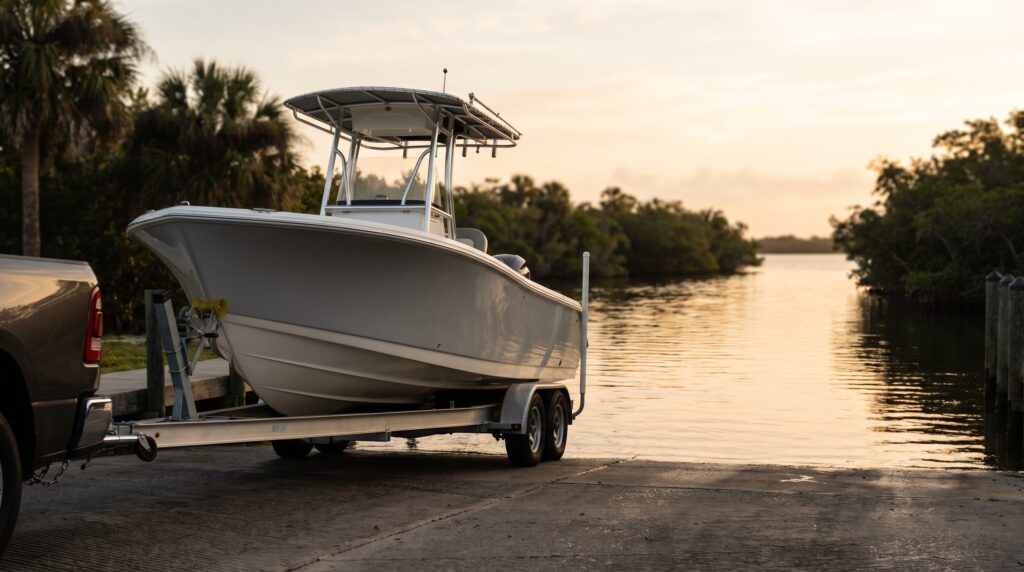
Towing a boat can feel straightforward—hook up, pull out, and head to the ramp. But trailering problems happen fast: a wrong-size hitch ball, a loose coupler, unbalanced load, or a simple wiring issue can turn a fun day on the water into a dangerous roadside situation.
Below are the most common boat towing errors we see (and how to prevent them), plus a Florida-focused pre-trip checklist, tips for launching day, and a quick guide to what insurance may (and may not) cover if something goes wrong.
Common Boat Towing Errors (and How to Avoid Them)
1) Disconnected or non-working trailer lights
This is still one of the most common mistakes—and one of the easiest to prevent. Before you roll, check that your brake lights, tail lights, and turn signals work. Have someone stand behind the trailer while you test signals and brakes.
- Confirm the electrical connector is fully seated and secure.
- Keep wiring supported (not dragging) so it doesn’t disconnect on turns.
- Carry spare bulbs or a small magnetic light kit as a backup.
2) Forgetting how differently your vehicle handles “with a boat in tow”
Even a capable tow vehicle becomes less responsive with a trailer behind it. You need more distance to stop, more room to turn, and more time to change lanes—especially on Florida highways where traffic can compress quickly.
- Increase following distance (think “double what feels normal”).
- Brake earlier and more smoothly—avoid panic braking.
- Take turns wider; watch curbs, poles, and gas station posts.
- Plan your route to reduce last-minute merges and tight turns.
3) Ignoring tow ratings and real-world load (boat + gear + fuel)
Tow capacity isn’t just the dry boat weight on paper. Add fuel, batteries, coolers, anchors, fishing gear, water toys, and passengers’ gear—and you can exceed limits faster than you think. Overloading increases strain on brakes, suspension, transmission, and tires.
- Check your vehicle’s tow rating and payload limits in the owner’s manual.
- Verify the trailer’s GVWR and the hitch receiver’s rating.
- Confirm tire pressure on both the tow vehicle and trailer tires.
4) Using the wrong size (or wrong rated) hitch ball
Hitch balls come in several common sizes (for example: 1 7/8”, 2”, 2 5/16”). A mismatched ball/coupler can allow slop, popping, or even a dangerous disconnect. Make sure the ball size matches the coupler exactly and that the ball and mount are rated for your load.
- Match coupler size to ball size (no “close enough”).
- Confirm the ball’s weight rating and the mount’s rating.
- Lock the coupler and verify it’s fully seated on the ball.
5) Skipping safety chains and tie-downs
Safety chains and tie-down straps are not “optional accessories.” They’re critical backups if the coupler fails—and they help keep the boat stable on the trailer.
- Cross safety chains under the coupler (cradle style) when possible.
- Use rated straps at the stern and winch strap at the bow.
- Check strap condition: sun damage and fraying are common in Florida.
6) Poor tongue weight and load balance (trailer sway)
Trailer sway is one of the scariest towing events because it can escalate quickly at speed. A common cause is improper tongue weight or load placement. If you notice sway, don’t “fight it” by yanking the wheel—reduce speed smoothly and regain control.
- Keep heavy gear low and centered in the boat.
- Confirm the boat is properly positioned on the trailer bunks/rollers.
- If sway starts: hold steady, ease off the accelerator, and slow down gradually.
Some guidance notes that boat trailers often operate safely with a lower tongue-weight percentage than tall-profile travel trailers, but the correct number depends on your trailer and boat setup—follow your trailer manufacturer guidance first.
7) Not checking trailer tires (including the spare)
Trailer tires work hard and often sit for long periods—both conditions increase the risk of blowouts. Check for dry rot, cracking, low tread, and proper inflation. Make sure your spare is inflated and that you have the correct tools to change it on the shoulder.
- Inspect sidewalls for cracks and bulges.
- Check PSI cold before you leave.
- Carry a lug wrench that fits the trailer lugs.
8) Ignoring wheel bearings/hubs (the “hot hub” problem)
Wheel bearing failure is a classic boat-trailer breakdown—especially because trailers get backed into water repeatedly. Make it a habit to check hubs at stops. If a hub is unusually hot, you may have a bearing issue that needs service before it fails on the road.
Recent safety guidance suggests checking wheel hubs at every stop and treating excessive heat as a warning sign.
9) Forgetting trailer brakes (and how your stopping distance changes)
Even if your tow vehicle has great brakes, stopping a heavy boat and trailer is a different equation. Make sure your trailer brakes (if equipped) are functioning and adjusted properly.
Florida boating education resources state that trailers above certain weights must be equipped with brakes (and outline registration/titling thresholds).
10) Failing to secure gear inside the boat
Loose gear becomes a hazard on the highway. Seat cushions, coolers, life jackets, fishing rods, and skis can fly out—creating danger for drivers behind you and potentially damaging your boat.
- Latch hatches and compartments.
- Strap down coolers and large items.
- Remove anything lightweight that can catch wind.
A Simple Florida Boat Towing Pre-Trip Checklist
Use this checklist every time—even if you “only tow a few miles to the ramp.”
- Hitch & coupler: Correct ball size, coupler fully seated and locked, pin in place.
- Safety chains: Attached and crossed, with enough slack for turns (not dragging).
- Winch & straps: Winch strap tight; stern tie-downs snug; transom straps secure.
- Lights: Brake, tail, and turn signals working (test before departure).
- Tires: Trailer PSI correct, tread OK, no cracking; spare inflated.
- Bearings/hubs: No grinding noises; hubs feel normal (not excessively hot at stops).
- Brakes: Trailer brakes working (if equipped) and controller adjusted (if applicable).
- Load: Gear secured; weight balanced; boat positioned correctly on the trailer.
How much could you save on Florida Boat Insurance? It takes two minutes to find out.
Get a Free QuoteLaunching Day Mistakes That Cause Accidents (and Embarrassing Ramp Moments)
Don’t rush at the ramp
Most ramp errors happen because drivers feel pressured with a line behind them. Prep in the staging area: remove straps (except the winch strap), load gear, install drain plug, and assign roles.
Practice backing up before the “real” day
If you’re new to towing, back a trailer in an empty parking lot first. Learn how the trailer responds and how to correct small deviations early—before you’re trying to back down a crowded ramp.
Insurance Angle: What Happens If Something Goes Wrong While Towing?
Towing incidents can involve multiple policies and coverages. Examples include:
- Damage to your boat: Often addressed under a boat (watercraft) policy, depending on the cause of loss and your coverage.
- Liability if you cause a crash: May involve your auto liability and/or boat policy liability depending on circumstances; liability complexity is one reason many boat owners talk with an agent before trailering frequently.
- Trailer considerations: Trailer coverage can vary; some policies include trailer coverage or endorsements (confirm specifics with your agent/carrier).
- Extra liability protection: A personal umbrella policy can extend liability limits beyond underlying policies (home/auto/boat) depending on your setup and carrier requirements.
If you trailer often—or tow long distances across Florida—it’s worth reviewing your boat policy details and liability limits ahead of time. GreatFlorida agents can help you compare options from multiple carriers and align coverages with how you actually use your boat.
Get a Florida Boat Insurance Quote
Need help insuring your boat (and making sure your trailering setup is covered the way you expect)? Talk with a local GreatFlorida agent or request a quote online.
Explore Florida boat insurance with GreatFlorida.
FAQs: Boat Towing in Florida
1) What are the most common boat towing mistakes?
The most common mistakes include non-working trailer lights, using the wrong hitch ball size, skipping safety chains or tie-down straps, exceeding tow ratings, poor load balance that causes sway, and neglecting trailer tires and wheel bearings.
2) Do boat trailers need working brake lights and turn signals in Florida?
Florida boating education resources summarize that trailers must have proper lighting, including turn signals, taillights, and brake lights.
3) Are safety chains and tie-down straps required for boat trailers in Florida?
Florida boating education resources state that trailers must be equipped with safety chains and tie-down straps.
4) How do I know if my hitch ball size is correct?
Your hitch ball must match the trailer coupler size exactly (for example 1 7/8”, 2”, or 2 5/16”). Also confirm the ball and mount are rated to meet or exceed the loaded trailer weight.
5) What causes trailer sway when towing a boat?
Common causes include improper tongue weight, uneven load placement, high speeds, and sudden steering inputs. If sway begins, hold the steering wheel steady and slow down gradually rather than making sharp corrections.
6) How often should I check my trailer hubs or wheel bearings on a trip?
It’s smart to check at each stop. If a hub feels unusually hot, that can be a warning sign of a bearing problem that should be serviced before it fails on the road.
7) What should I check before towing my boat to the ramp?
Verify hitch and coupler lock, safety chains, straps/winch, working lights, tire pressure (including the spare), brake function (if equipped), and that gear inside the boat is secured.
8) Do I need trailer brakes in Florida?
Florida boating education resources describe brake requirements based on trailer weight and also summarize Florida trailer registration/titling thresholds. Because rules can depend on weight and configuration, confirm your trailer’s rating and compliance before long trips.
9) Does boat insurance cover trailering incidents?
Coverage depends on your policy, the cause of loss, and the coverages you selected. Many boat owners review trailer-related scenarios and liability limits with an agent so there are no surprises after an accident.
10) Should I consider an umbrella policy if I tow a boat regularly?
An umbrella policy can add additional liability protection above underlying home/auto/boat policies (subject to carrier requirements and policy terms). If you’re concerned about lawsuit exposure from a towing-related accident, it’s worth discussing.
Contact GreatFlorida Insurance today to get a quote for boat insurance today. Our offices are located throughout Florida for your convenience.
Ready to save on Florida Boat Insurance?
GreatFlorida Insurance Agents compare rates from Florida's best carriers for you.
Get a Free QuoteOr call 888.478.7801