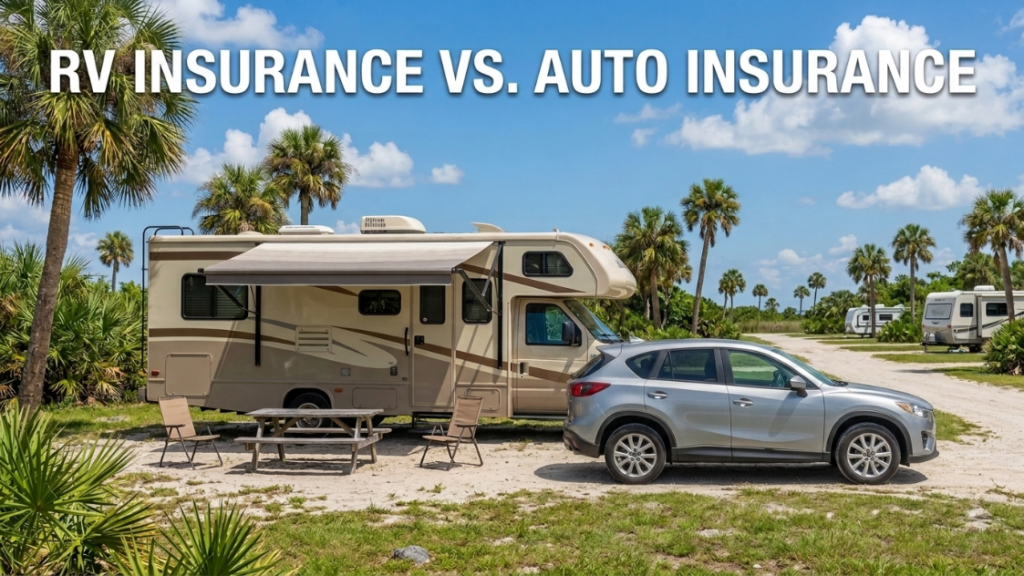
At first glance, RV insurance and auto insurance may seem almost the same. Both involve vehicles. Both may include liability coverage. Both may protect against accidents, theft, weather damage, and damage to the vehicle itself. Both can be important if you drive on public roads.
But GreatFlorida Insurance can assure you, RV insurance and auto insurance are not the same.
A personal auto insurance policy is designed primarily for ordinary passenger vehicles such as cars, SUVs, pickup trucks, and vans. RV insurance is designed for recreational vehicles that may function as both a vehicle and a temporary living space.
That difference matters. An RV may carry furniture, appliances, bedding, personal belongings, camping gear, electrical systems, plumbing, propane, awnings, slide-outs, attached accessories, and sometimes even people living in it for extended periods. A standard auto policy is not built to cover all of those exposures.
The National Association of Insurance Commissioners notes that auto insurance coverage depends on the specific coverages selected, policy conditions, limits, and exclusions. It also explains that a standard auto policy may not cover motorcycles, ATVs, off-road vehicles, recreational vehicles, or commercial vehicles.
For Florida drivers and RV owners, the key question is not just whether the RV can be driven. The better question is: does your insurance match how the RV is used?
What Is Auto Insurance?
Auto insurance is designed to protect drivers from financial loss related to personal vehicles. A typical auto policy may include several coverage types.
Liability coverage may help pay for injury or property damage you cause to others in an accident.
Personal injury protection may help pay certain medical expenses and lost wages after an accident, depending on state law and policy terms.
Property damage liability may help pay for damage you cause to someone else’s vehicle or property.
Collision coverage may help pay to repair or replace your vehicle after a collision.
Comprehensive coverage may help pay for non-collision damage such as theft, vandalism, fire, hail, falling objects, or certain weather-related damage.
Uninsured or underinsured motorist coverage may help if another driver causes injury and has no insurance or not enough insurance.
Rental reimbursement and roadside assistance may also be available.
Florida Highway Safety and Motor Vehicles states that vehicles with a current Florida registration must maintain Florida insurance coverage continuously throughout the registration period.
Auto insurance works well for a regular car, but an RV often creates additional risks.
What Is RV Insurance?
RV insurance is a specialized policy designed for recreational vehicles. It may include many of the same core coverages as auto insurance, but it can also include coverage tailored to RV ownership.
Depending on the policy, RV insurance may cover:
Motorhome liability
Collision damage
Comprehensive damage
Personal belongings
Attached accessories
Awnings
Slide-outs
Emergency expenses
Vacation liability
Campsite liability
Roadside assistance
Towing
Full-timer liability
Replacement cost options
Custom equipment
Total loss replacement
Uninsured or underinsured motorist coverage
The right coverage depends on the type of RV, how often it is used, where it is stored, whether it is financed, whether it is driven or towed, and whether it is used occasionally or as a primary residence.
Motorhomes vs. Travel Trailers
One major difference between auto insurance and RV insurance is that not all RVs are driven the same way.
A motorhome has its own engine. This includes Class A, Class B, and Class C motorhomes. Since motorhomes are driven on public roads, they generally need liability coverage similar to auto insurance.
A travel trailer, fifth wheel, pop-up camper, or toy hauler is towed by another vehicle. The tow vehicle’s liability coverage may extend to the trailer while it is being pulled, depending on the policy. However, that may not protect the trailer itself from physical damage, theft, fire, storm damage, or damage while parked.
This is one of the biggest misunderstandings RV owners have. A tow vehicle’s auto policy may help with liability while towing, but that does not mean the trailer is fully insured.
If you want protection for the RV’s value, contents, accessories, and campsite exposures, a separate RV policy may be needed.
Vacation Liability Coverage
Vacation liability is one of the most important differences between RV insurance and auto insurance.
Vacation liability may help if someone is injured in or around your RV while it is being used as a temporary vacation residence. For example, if a guest trips on the steps at your campsite, slips near your awning, or is injured while visiting your RV, vacation liability may help with covered claims.
A standard auto policy is not designed for that kind of exposure. It generally treats the vehicle as transportation, not as a temporary home.
For Florida RV owners who camp at state parks, private campgrounds, beach resorts, RV parks, or seasonal lots, vacation liability can be an important coverage to review.
Full-Timer RV Coverage
Some people use an RV only a few weekends a year. Others live in an RV for months at a time or use it as their primary residence.
Full-timer RV coverage is designed for people who use their RV as a home. It may include broader liability protection, personal property coverage, medical payments, and additional living expense options that are more similar to homeowners or renters insurance.
This is very different from standard auto insurance.
If you live in your RV full time or for extended periods, tell your insurance agent. Do not assume a basic RV policy is enough. A policy designed for occasional recreational use may not be appropriate for full-time living.
Personal Belongings Inside the RV
A car may contain personal items, but an RV often contains much more.
An RV may include clothing, bedding, kitchenware, electronics, tools, camping gear, grills, chairs, bikes, fishing equipment, paddleboards, appliances, laptops, and other personal property.
Auto insurance generally provides limited or no protection for personal belongings inside a vehicle. If your laptop is stolen from your car, that may be handled by homeowners or renters insurance, not auto insurance.
RV insurance may offer personal belongings coverage, but limits and exclusions matter. Expensive items such as jewelry, camera equipment, bikes, sporting equipment, tools, or electronics may need special attention.
Before buying RV insurance, ask how much personal property coverage is included and whether your belongings are covered while inside, outside, or attached to the RV.
Attached Accessories and Equipment
RVs often have accessories and specialized equipment that standard auto insurance may not contemplate.
Examples include:
Awnings
Satellite dishes
Solar panels
Bike racks
Roof racks
Ladders
Generators
Slide-outs
Leveling systems
Custom storage
Outdoor kitchens
Towing equipment
Attached steps
Aftermarket electronics
If these items are damaged, stolen, or destroyed, coverage may depend on how they are listed in the policy.
An RV policy may provide accessory coverage or allow you to add coverage for custom equipment. Auto insurance generally does not provide the same level of RV-specific protection.
Emergency Expense Coverage
Emergency expense coverage is another RV-specific feature.
If your RV is damaged in a covered loss while you are away from home, emergency expense coverage may help pay for lodging, transportation, or other temporary costs.
This matters because an RV claim can disrupt both transportation and housing. If your car breaks down, you may need a rental car. If your RV is damaged during a trip, you may need a hotel, transportation, and a way to get home.
Some RV policies include or offer emergency expense coverage. The amount and conditions vary by policy.
How much could you save on Florida Auto Insurance? It takes two minutes to find out.
Get a Free QuoteRoadside Assistance and Towing
Roadside assistance for an RV can be more complicated and expensive than roadside assistance for a car.
A standard auto towing benefit may not be enough for a large motorhome, fifth wheel, or travel trailer. RV towing may require specialized equipment, longer towing distances, heavy-duty service, tire assistance, mobile mechanics, or help with a trailer.
RV policies may offer specialized roadside assistance for larger vehicles and trailers. If you travel long distances, camp in rural areas, or tow a large trailer, review towing coverage carefully.
Storage and Seasonal Use
Many RVs are not used every day. Some are used seasonally and stored for months at a time.
This creates different insurance questions than a regular car.
If your RV is stored during the off-season, you may still want comprehensive coverage for theft, fire, vandalism, storm damage, falling objects, or animal damage. In Florida, stored RVs may also face hurricane exposure, flooding, humidity, mold, and wind damage.
Some insurers may offer storage options or reduced-use endorsements, but you should be careful before reducing coverage. If the RV is financed, the lender may require physical damage coverage year-round.
Florida Weather and Hurricane Risk
Florida RV owners should think carefully about weather risk.
RVs can be vulnerable to hurricanes, tropical storms, flooding, falling trees, hail, wind-driven debris, and water intrusion. Even if the RV is parked, it may be damaged at a campground, storage lot, driveway, or seasonal site.
Comprehensive coverage may help with certain non-collision losses, but policy terms matter. Flood, storm surge, named storm deductibles, storage requirements, and evacuation issues should be reviewed.
If the RV is parked in a low-lying area, near the coast, or in a storage lot during hurricane season, ask whether your policy includes flood or storm-related damage and whether any exclusions apply.
Campsite and Premises Liability
When an RV is parked at a campsite, it can create a small premises liability exposure.
Someone may trip over a power cord, fall near the steps, get hurt under the awning, or be injured while visiting your campsite. Children may play around the RV. Guests may sit outside. Neighbors may walk through shared campground areas.
Auto insurance is not designed to handle these campsite situations. RV insurance may provide vacation liability or campsite liability coverage, depending on the policy.
This can be especially important for Florida RV owners who spend time at campgrounds, RV resorts, beaches, state parks, sporting events, and seasonal communities.
Rental or Business Use
If you rent out your RV or use it for business, your insurance needs may change significantly.
A personal RV policy may exclude rental use, delivery use, commercial use, or business operations. If you list your RV on a peer-to-peer rental platform, provide it as part of a vacation rental, use it as a mobile office, or use it for business travel, you should review coverage carefully.
Commercial or rental RV insurance may be needed.
Do not assume a personal auto or personal RV policy will cover income-producing use.
Does Auto Insurance Cover a Rental RV?
A personal auto policy may cover a rental car, but a rental RV is different. Some auto policies exclude recreational vehicles, large vehicles, or vehicles rented for extended periods. Credit card rental car benefits may also exclude RVs.
The NAIC cautions consumers that auto insurance coverage depends on the specific coverage purchased and policy conditions. It also notes that an auto policy may not cover recreational vehicles.
Before renting an RV, call your auto insurer, credit card company, and rental company. Ask what is covered, what is excluded, what deductible applies, and whether liability and physical damage are included.
Does RV Insurance Cost More Than Auto Insurance?
RV insurance may cost more or less than auto insurance depending on the RV.
A small travel trailer may cost less to insure than a daily-use car. A large Class A motorhome may cost much more. Premiums depend on many factors, including:
RV type
RV value
Age and condition
Motorhome vs. trailer
How often it is used
Where it is stored
Driving history
Coverage limits
Deductibles
Personal property coverage
Full-time use
Vacation liability
Hurricane and storm exposure
Claims history
Financing requirements
The best way to know the cost is to request a quote for the specific RV and how you plan to use it.
Do You Need Both Auto Insurance and RV Insurance?
In many cases, yes.
If you own a motorhome, you may need RV insurance for the motorhome and auto insurance for your personal car.
If you tow a travel trailer, you need auto insurance for the tow vehicle and may need RV insurance for the trailer’s physical damage, contents, and campsite liability.
If you rent an RV, you may need temporary coverage from the rental company or another source, depending on your existing insurance.
The right setup depends on whether the RV is driven, towed, financed, rented, stored, or lived in.
Questions to Ask Before Buying RV Insurance
Before buying RV insurance, ask:
Is my RV a motorhome, travel trailer, fifth wheel, toy hauler, or camper?
Does my auto policy provide any liability while towing?
Does it cover physical damage to the trailer?
Are personal belongings covered?
Are awnings, solar panels, bike racks, and accessories covered?
Is vacation liability included?
Do I need full-timer coverage?
Is emergency expense coverage included?
Does roadside assistance cover large RV towing?
Is hurricane, wind, or flood damage covered?
Are there storage requirements?
Is rental or business use excluded?
What deductible applies?
Does my lender require specific coverage?
Can umbrella insurance extend over my RV exposure?
These questions help make sure the policy matches how the RV is actually used.
Common Mistakes RV Owners Make
One common mistake is assuming auto insurance fully covers a travel trailer. The tow vehicle’s liability coverage may extend in some situations, but that does not mean the trailer itself is covered for damage or theft.
Another mistake is ignoring personal belongings. RVs often contain expensive items that may not be fully covered unless the policy includes enough contents coverage.
A third mistake is using an occasional-use policy while living in the RV full time. Full-time use needs to be disclosed and insured properly.
A fourth mistake is assuming roadside assistance for a car will work for a large RV. Specialized towing can be expensive.
A fifth mistake is forgetting Florida weather. RVs stored in Florida may need strong comprehensive coverage because of storms, flooding, wind, theft, and storage risks.
Before assuming your auto policy is enough, review your RV type, how it is used, where it is stored, what it carries, and whether people stay in it.
A GreatFlorida Insurance agent can help compare RV insurance and auto insurance so you can choose coverage that fits your travel plans, budget, and risk.
Ready to save on Florida Auto Insurance?
GreatFlorida Insurance Agents compare rates from Florida's best carriers for you.
Get a Free QuoteOr call 888.478.7801