


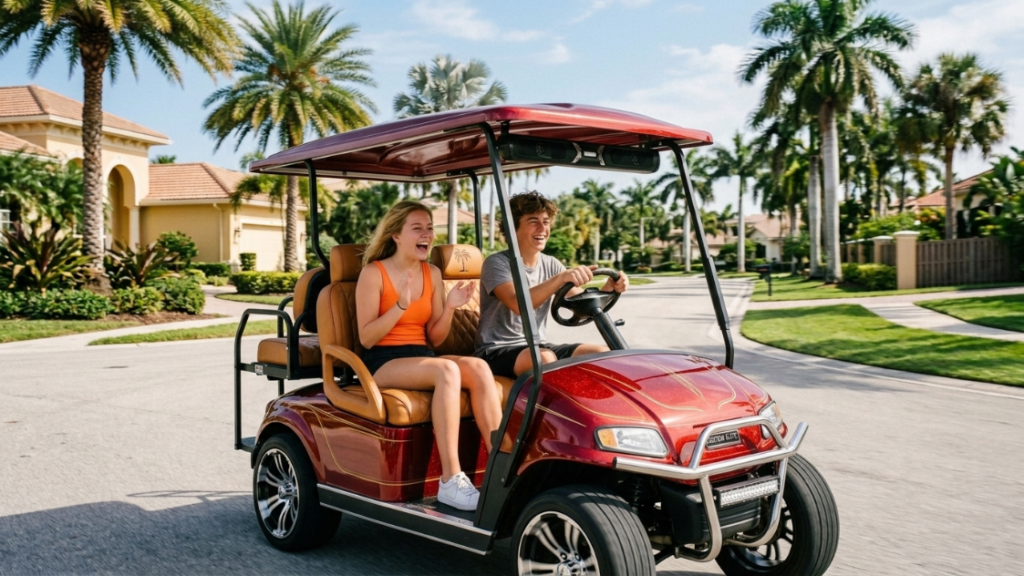
Golf carts are no longer used only on golf courses. Across Florida, they are common in retirement communities, beach towns, gated neighborhoods, campgrounds, resorts, college areas, and planned communities. Many people use them to visit neighbors, ride to the clubhouse, go to the beach, pick up mail, run short errands, or move around a private community.
But as golf carts become more popular, one question becomes more important: Do you need golf cart insurance in Florida?
The answer depends on how the golf cart is used, where it is driven, whether it is a true golf cart or a low-speed vehicle, and what type of protection you want. Florida law treats golf carts differently from low-speed vehicles, and that distinction can affect registration, insurance, driver requirements, and where the vehicle may be operated.
Even when insurance is not legally required for a standard golf cart, it may still be a smart decision. Golf carts can cause injuries, damage property, be stolen, catch fire, or be damaged in a storm. A basic homeowners policy may not provide the coverage you expect, especially if the cart is driven off your property.
Before buying or using a golf cart in Florida, it is important to understand the rules and the insurance options.
Golf Cart vs. Low-Speed Vehicle in Florida
One of the most important distinctions is whether the vehicle is a golf cart or a low-speed vehicle, often called an LSV.
Florida Highway Safety and Motor Vehicles explains that a low-speed vehicle is a vehicle with a top speed greater than 20 mph but not greater than 25 mph. LSVs must be registered, titled, and insured with personal injury protection and property damage liability coverage. They may only be operated on streets where the posted speed limit is 35 mph or less.
By contrast, FLHSMV describes golf carts as vehicles designed and manufactured for operation on a golf course for sporting or recreational purposes and not capable of exceeding 20 mph. FLHSMV also states that golf carts may be operated on designated roadways with a posted speed limit of 30 mph or less.
That difference matters. A cart that has been modified to go faster or meet street-legal standards may no longer be treated like a simple golf cart. It may need to be titled, registered, and insured as a low-speed vehicle.
Is Golf Cart Insurance Required in Florida?
For a standard golf cart, Florida law does not generally require the same insurance that applies to regular motor vehicles. In fact, Florida Statutes Section 320.105 states that golf carts and utility vehicles, when operated in accordance with certain Florida golf cart rules, are exempt from the chapter provisions requiring vehicle registration or license plates.
However, that does not mean you should assume you have no risk.
If your cart qualifies as a low-speed vehicle, Florida requires registration, title, and insurance. FLHSMV states that LSVs must carry Florida insurance, including at least $10,000 in property damage liability and $10,000 in personal injury protection.
Also, private communities, HOAs, golf courses, rental communities, resorts, marinas, campgrounds, or municipalities may have their own insurance requirements. Even if the state does not require a policy for your specific cart, your community or lender might.
Where Can Golf Carts Be Driven in Florida?
Florida does not allow golf carts on all public roads. Under Florida Statutes Section 316.212, operation of a golf cart on public roads or streets is prohibited except as specifically allowed by law. Golf carts may be operated only on designated county roads, municipal streets, certain two-lane county roads within a municipality, or roads owned and maintained by a water control district when the proper governmental entity has designated the road for golf cart use.
The responsible local government must determine that golf carts can safely travel on or cross the road and must post appropriate signs showing that golf cart operation is allowed.
In other words, you should not assume that a golf cart can be driven anywhere just because other people are using one nearby. Local rules matter. Neighborhoods, beach towns, retirement communities, and municipalities may each have different requirements.
Driver Rules for Golf Carts in Florida
Florida also has rules for who may operate a golf cart on public roads or streets where golf carts are allowed.
Under Florida Statutes Section 316.212, a person under 18 may not operate a golf cart on public roads or streets unless they have a valid learner’s driver license or valid driver license. A person who is 18 or older must possess a valid form of government-issued photo identification.
This is especially important for families. Golf carts may feel casual, but they are still vehicles. Teen drivers, visiting relatives, guests, and neighbors should understand the rules before operating the cart.
If a child, guest, or unapproved driver causes an accident, insurance coverage can become complicated depending on the policy and circumstances.
What Golf Cart Insurance May Cover
Golf cart insurance can vary by company and policy, but it may include several important coverages.
Liability Coverage
Liability coverage may help if you injure someone or damage someone else’s property while operating the golf cart. For example, if you hit a parked vehicle, damage a neighbor’s fence, or injure a pedestrian, liability coverage may help with covered claims.
Physical Damage Coverage
Physical damage coverage may help repair or replace your golf cart if it is damaged by a covered event. This may include collision, theft, fire, vandalism, or certain weather-related damage, depending on the policy.
Medical Payments Coverage
Medical payments coverage may help pay certain medical expenses if you or your passengers are injured while using the golf cart, regardless of fault, depending on the policy.
Uninsured or Underinsured Motorist Coverage
If your golf cart is involved in an accident with another vehicle and the other driver has no insurance or not enough insurance, uninsured or underinsured motorist coverage may be helpful if available.
Accessories and Custom Equipment
Many Florida golf carts are customized with upgraded seats, sound systems, lights, enclosures, lift kits, wheels, storage racks, coolers, or beach gear holders. These upgrades may not be fully covered unless the policy includes accessory or custom equipment coverage.
How much could you save on Florida Homeowners Insurance? It takes two minutes to find out.
Get a Free QuoteDoes Homeowners Insurance Cover a Golf Cart?
Some homeowners insurance policies may provide limited coverage for golf carts, especially while used on your own property or on a golf course. But coverage is often limited and may not extend to public roads, neighborhood streets, HOA communities, or modified carts.
This is one of the most common misunderstandings. A homeowner may assume, “It is stored in my garage, so my homeowners policy covers it.” That may not be true, or it may be true only in limited situations.
Ask your GreatFlorida Insurance agent:
Does my homeowners policy cover the golf cart?
Does coverage apply away from my property?
Does liability apply if I drive it in my neighborhood?
Are passengers covered?
Are children or guests allowed to drive it?
Is theft covered?
Are custom parts covered?
Is the cart excluded if it is modified or street legal?
If you use the cart beyond your own property, a separate golf cart policy may provide clearer protection.
Golf Cart Insurance vs. LSV Insurance
Golf cart insurance and LSV insurance are not always the same.
A standard golf cart is generally designed for golf course or recreational use and cannot exceed 20 mph. A low-speed vehicle can go faster than 20 mph but not faster than 25 mph and must meet certain safety equipment requirements, including items such as headlamps, mirrors, parking brake, tail lamps, stop lamps, reflex reflectors, seat belts, vehicle identification number, turn signals, and windshield.
If a golf cart is converted into an LSV, FLHSMV states that it must be inspected, assigned a VIN, titled, registered, and insured before it can be operated as an LSV.
This distinction is critical. If you modify a golf cart to make it faster or street legal, do not assume your old golf cart coverage still applies. You may need a different type of policy.
Common Golf Cart Risks in Florida
Golf carts may move slower than cars, but accidents can still happen. Common risks include:
Collisions with cars, pedestrians, bicycles, other carts, curbs, mailboxes, signs, fences, or parked vehicles.
Passenger injuries from sudden turns, falls, or rollovers.
Property damage in neighborhoods, private communities, resorts, or parking areas.
Theft from garages, driveways, storage areas, rental homes, or vacation properties.
Storm damage from hurricanes, wind, flood, falling branches, or flying debris.
Battery fires or electrical issues, especially with charging systems.
Vandalism or damage while parked in public areas.
Because Florida golf carts are often used near beaches, marinas, resorts, and communities with pedestrian traffic, liability coverage can be just as important as physical damage coverage.
Golf Carts in HOAs and Retirement Communities
Many Florida communities have their own golf cart rules. Some require proof of insurance. Some require registration with the HOA. Some restrict who may drive. Others require headlights, reflectors, seat belts, decals, or specific routes.
Retirement communities, gated neighborhoods, and master-planned communities may allow golf carts on private roads even where public road use is more limited. But private permission does not always mean you are automatically insured.
If you live in a golf cart-friendly community, review both the community rules and your insurance policy. Ask whether your policy covers operation on private community roads, common areas, sidewalks, parking lots, and golf cart paths.
Golf Cart Rentals and Vacation Homes
Golf carts are common at vacation rentals, beach communities, resorts, and campgrounds. If you rent a golf cart while on vacation or provide one at a short-term rental property, insurance needs can become more complicated.
A personal golf cart policy may not cover business use, rental use, or guests using the cart as part of a vacation rental. If a guest is injured or causes damage while using a cart provided with a rental home, the claim may involve homeowners insurance, short-term rental insurance, commercial coverage, or a specialty golf cart policy.
If you own a vacation rental and provide a golf cart, talk with an insurance agent before allowing guests to use it. Do not assume personal coverage applies.
How Much Does Golf Cart Insurance Cost in Florida?
Golf cart insurance is often relatively affordable compared with auto insurance, but the cost depends on several factors. These may include the type of cart, value, speed, whether it is street legal, where it is used, driver history, coverage limits, deductibles, and whether custom equipment is included.
A basic golf cart policy may cost less than a standard auto policy, but a street-legal low-speed vehicle may cost more because it is registered, titled, insured, and driven on public roads.
The best way to know the cost is to get a quote based on your specific cart and usage.
Questions to Ask Before Buying Golf Cart Insurance
Before choosing coverage, ask your agent:
Is my vehicle considered a golf cart or a low-speed vehicle?
Is insurance legally required for how I use it?
Does my HOA or community require coverage?
Does the policy cover public road use where permitted?
Are passengers covered?
Can family members or guests drive it?
Are teen drivers excluded or restricted?
Is theft covered?
Is storm damage covered?
Are custom parts and accessories covered?
Does coverage apply at a vacation property or campground?
Is rental or business use excluded?
Do I need umbrella insurance over this exposure?
These questions can help prevent surprises after a claim.
Final Thoughts
Golf carts are part of the Florida lifestyle, but they still create insurance and liability questions. Whether you use one in a retirement community, beach town, campground, neighborhood, or golf course, it is important to understand the difference between a standard golf cart and a low-speed vehicle.
Florida does not generally require registration or license plates for standard golf carts operated under the applicable golf cart rules, but LSVs must be titled, registered, and insured. Local rules, HOA requirements, and community guidelines may also apply.
Even when coverage is not legally required, golf cart insurance may help protect against liability, theft, damage, medical costs, and custom equipment losses. A local GreatFlorida Insurance agent can help you determine whether your homeowners policy provides any protection, whether a separate golf cart policy is needed, and whether your cart is actually an LSV under Florida law.
Before you drive, confirm the rules, review your coverage, and make sure your golf cart is protected for the way you actually use it.
Ready to save on Florida Homeowners Insurance?
GreatFlorida Insurance Agents compare rates from Florida's best carriers for you.
Get a Free QuoteOr call 888.478.7801